

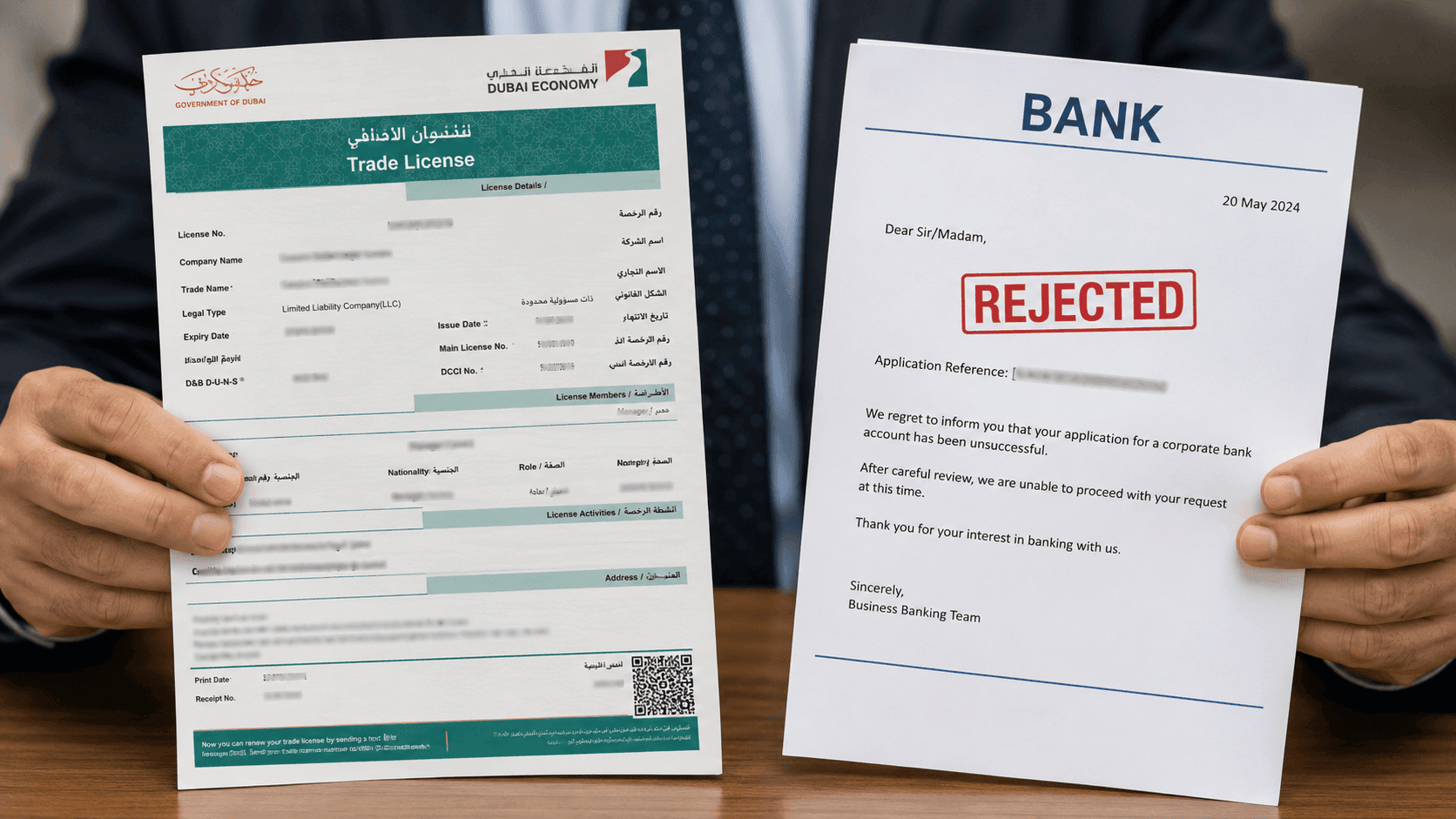
Opening a UAE trade license takes as little as three working days. Opening a corporate bank account can take three months or fail entirely if you approach it wrong.
This is the reality most business setup guides do not tell you. UAE banks operate under some of the most rigorous KYC (Know Your Customer) and AML (Anti-Money Laundering) frameworks in the world, enforced directly by the UAE Central Bank. Every new corporate account application goes through a compliance review process that has become significantly stricter since 2022. Banks that approve problematic accounts face heavy regulatory penalties so their compliance teams err heavily on the side of caution.
The result is that thousands of legitimate businesses are rejected or indefinitely delayed every year not because their business is problematic, but because their application was not prepared correctly.
This guide covers the 8 most common reasons UAE banks reject company bank account applications in 2026, what you can do to fix each one before you apply, and how to give your application the best possible chance of approval.
At Azha Commercial Brokers, we have managed over 500 corporate bank account cases across UAE banks including startups, established companies, high-risk activities, and complex nationality cases. Everything in this guide comes from direct experience with what UAE bank compliance teams accept and reject.
Why a UAE Corporate Bank Account Is Non-Negotiable
Before getting into rejection reasons, it is worth being clear about why this step cannot be skipped or worked around.
A UAE trade license gives you the legal right to operate. A corporate bank account makes that operation actually functional. Without one, you cannot receive payments from clients through official channels, you cannot run payroll through the UAE Wage Protection System (WPS), you cannot apply for employee visa quotas at certain authorities, you cannot make or receive international wire transfers for business purposes, and you cannot build the banking relationship that supports future financing needs.
Operating through a personal account for business purposes violates UAE Central Bank regulations and can result in your personal account being frozen. It also raises serious red flags when you eventually do apply for a corporate account banks can see prior transaction history and will question why business funds were flowing through a personal account.
There is no legal workaround. A corporate bank account is as essential as the trade license itself.

The 8 Main Reasons UAE Banks Reject Company Bank Account Applications
1. Incomplete or Incorrect Documentation
This is the most common rejection reason and the most entirely preventable. UAE bank compliance teams work from a defined checklist. If one item is missing, incorrect, expired, or in the wrong format, the application is either rejected outright or placed in a queue for document requests which can add weeks to the timeline.
Common documentation failures include submitting an expired or soon-to-expire trade license, providing passport copies that are unclear, expired, or not properly attested, submitting an MOA that does not match the current shareholder structure, missing the Certificate of Incorporation for free zone companies, providing no tenancy agreement or flexi-desk proof, submitting a vague or missing business plan, and providing no personal bank statements for shareholders.
The Fix: Compile every document before approaching any bank. Do not go to a bank to find out what you need go with everything already prepared. Banks treat complete applications as higher priority. A relationship manager with a complete file can move it to compliance within days. An incomplete file sits in a pending queue indefinitely.
Use the full document checklist in this article before your first submission.
2. High-Risk Business Activity
UAE banks are required to apply Enhanced Due Diligence (EDD) to business activities that carry elevated money laundering or financial crime risk. If your trade license lists one of these activities, your application automatically triggers a deeper compliance review.
Activities consistently flagged as higher risk by UAE banks include cryptocurrency and digital asset trading, forex trading and money exchange, gold, diamonds, and precious metals trading, real estate brokerage and property investment, arms and defense-related equipment, cash-intensive retail and wholesale businesses, import and export of controlled or dual-use goods, charitable organizations and NGOs receiving international funding, and payment processing or money service businesses.
Being in a higher-risk category does not mean bank account opening is impossible. It means your application needs to be significantly stronger and more detailed than a standard submission.
The Fix: Prepare a thorough business plan that goes well beyond a basic description. Include your specific products or services with full descriptions, your client profile with named client types or actual clients if available, your supplier chain with countries of origin, your revenue model and expected monthly transaction volumes, and any regulatory approvals you hold such as VARA approval for crypto-related activities. The business plan needs to answer every question a compliance officer might have before they ask it.
3. High-Risk Nationality
UAE banks apply different levels of compliance scrutiny based on applicant nationality. This is driven by international frameworks primarily FATF (Financial Action Task Force) guidance not by bank-level discrimination.
Passport holders from Pakistan, India, Nigeria, Kenya, Ghana, Russia, Iran, Afghanistan, Iraq, Egypt, and several other countries routinely face additional compliance review under what banks call Enhanced Due Diligence. This list is not static it updates based on FATF assessments and UAE Central Bank guidance.
This additional scrutiny does not mean automatic rejection. Thousands of Pakistani, Indian, Nigerian, and Russian entrepreneurs successfully open UAE corporate accounts every year. It means the application must be more thoroughly documented, submitted to the right bank, and in many cases managed by someone who has existing relationships with the bank’s compliance team.
The Fix: Applicants from higher-scrutiny nationalities should prepare an apostilled or notarized passport copy, a criminal background check or police clearance certificate from their country of origin, a source of wealth declaration covering overall financial history not just current funds, a reference letter from their home country bank on official letterhead signed by a branch manager, professional background documentation including degree certificates and employment history, and a detailed business plan with a clear explanation of UAE market connection.
Bank selection also matters significantly for these cases. RAKBANK and Wio Bank have historically shown higher approval rates for complex nationality applications than Emirates NBD or FAB.

4. Unclear or Unverifiable Source of Funds
UAE banks must trace the origin of all funds entering a new corporate account. This is a core AML requirement banks need to confirm that startup capital and operating funds are not connected to illegal activity, corruption, or sanctions violations.
If you cannot clearly document where your money is coming from, most banks will reject the application immediately during compliance review.
Common source-of-funds problems include no personal bank statements showing prior savings or income, a large unexplained cash deposit appearing in a personal account shortly before the application, capital injection from a third party with no formal agreement or explanation, investor funds without a signed investment or shareholder agreement, and salary or business income from a source that cannot be independently verified.
The Fix: Provide at least six months of personal bank statements for all shareholders showing a legitimate income or savings pattern. If startup capital comes from personal savings, the statements should clearly reflect this accumulation over time. If capital is coming from an investor, provide a formal investment agreement with the investor’s details and source of wealth. If it is from a loan, provide the full loan agreement. If it is from the sale of property or an asset, provide the sale documentation. Never deposit large sums of cash into a personal account immediately before applying this is precisely the pattern AML systems are designed to flag.
5. Weak or Vague Business Plan
“General Trading” is the most commonly registered business activity on UAE trade licenses and it is also one of the most common triggers for bank account rejection. A license that says “General Trading” with no further explanation tells a bank’s compliance officer absolutely nothing about what the business actually does.
Banks are required under UAE Central Bank regulations to understand the nature of every business they bank. If your business plan does not give them that understanding, the application cannot proceed. Compliance teams cannot approve what they cannot classify.
Beyond General Trading, common business plan failures include no description of actual products or services, no identification of customer types or markets, no explanation of supplier relationships, no projected transaction volumes, and no clear explanation of why the UAE was chosen as the business base.
The Fix: Write a focused two page business plan that answers six questions: What does your company sell or do specifically? Who are your customers business type, location, industry? Who are your suppliers or service partners names, countries, transaction structure? How does revenue flow in payment methods, currencies, frequency? How do funds flow out salaries, supplier payments, profit repatriation? What is your expected monthly transaction volume in AED?
This document does not need to be long. It needs to be specific. A two-page specific business plan outperforms a ten-page generic one every time.
6. No UAE Physical Presence
UAE banks expect businesses to have a genuine physical connection to the country. A company whose shareholders all live overseas, whose office is entirely virtual, and which has no UAE phone number or local contact raises significant flags in compliance review.
This is a particular problem for free zone companies using virtual offices only. While a virtual office is legally valid for licensing purposes, several UAE banks particularly Emirates NBD, FAB, and some ADCB branches do not consider a virtual office address sufficient for account opening. They want to see evidence of real operational presence.
The Fix: Ensure your flexi-desk or office agreement is current and not expired. Obtain a UAE mobile number registered to the company or to a UAE-resident shareholder. Have at least one shareholder or director physically present in the UAE during the application period if possible. If your setup is entirely virtual, target banks that have demonstrated flexibility on this requirement Wio Bank and RAKBANK are generally more accommodating than larger institutional banks. Consider upgrading from a virtual office to a physical flexi-desk arrangement if this is creating a consistent barrier.
7. Applying to Multiple Banks Simultaneously
This is the mistake that surprises most applicants because it feels logical if one bank might say no, surely applying to several at once increases your chances? In UAE banking, the opposite is true.
UAE banks share compliance information through industry networks and the UAE Central Bank reporting system. When Bank B’s compliance team sees that you also submitted applications to Banks A and C within the same period, it immediately raises a question: why is this company applying to three banks at once? Legitimate businesses typically open one account with one bank. Multiple simultaneous applications signal either desperation, a prior rejection, or an attempt to obscure information by diluting it across institutions.
The result is that your application gets scrutinized more heavily, not less and all three may reject you when any one of them might have approved you individually.
The Fix: Submit to one well-matched bank at a time. Work with a consultant who can identify the right bank for your specific profile before submitting. If the first bank declines, identify the reason, address it, and then approach a second bank with an improved application. This sequential approach takes longer in theory but results in a higher overall approval rate than the simultaneous approach.
8. Previous Banking Issues or Sanctions Matches
This is the most serious rejection category. If any shareholder or director in your company has a history of banking problems, a sanctions match, a fraud flag, or a prior AML investigation in any country, the application will almost certainly be rejected during KYC screening.
UAE banks run all applicants against multiple international sanctions and watchlist databases during the KYC process. These checks happen automatically and include OFAC (US Treasury Office of Foreign Assets Control), UN Security Council sanctions lists, EU consolidated sanctions lists, UAE Central Bank watchlists, and various commercial compliance databases like World-Check and Refinitiv.
Common issues in this category include a name that matches or partially matches a sanctions list entry, a previous UAE or foreign bank account that was frozen or involuntarily closed, a fraud, financial crime, or AML investigation in any jurisdiction even without a conviction, and association with a sanctioned entity or individual through shared business ownership.
The Fix: If you suspect any of these issues may affect your application, address them proactively before approaching any bank. A legal clearance letter from a UAE-based legal firm, a notarized affidavit confirming no sanctions history, or a formal compliance assessment letter can provide banks with the documentation they need to clear a false positive or address a legitimate concern. For serious prior banking history issues, engaging a professional compliance consultant before approaching any bank is essential a poorly managed first submission with a problematic history can permanently close options that might otherwise have been available.
UAE Bank-by-Bank Comparison Corporate Account Opening 2026
Bank | Min. Monthly Balance | Risk Tolerance | Best For | Timeline |
|---|---|---|---|---|
Emirates NBD | AED 50,000 | Medium | Established companies, high turnover | 3–6 weeks |
First Abu Dhabi Bank (FAB) | AED 50,000 | Low | Large corporates, institutional | 4–8 weeks |
Mashreq Bank | AED 25,000 | Medium | Trading companies, SMEs | 2–4 weeks |
RAKBANK | AED 25,000 | Higher | SMEs, startups, complex nationalities | 2–3 weeks |
Abu Dhabi Islamic Bank (ADIB) | AED 10,000 | Medium | Islamic banking preference | 3–5 weeks |
ADCB | AED 25,000 | Medium | General business, professionals | 3–5 weeks |
Commercial Bank of Dubai (CBD) | AED 25,000 | Medium | Trading, import/export | 3–5 weeks |
Wio Bank (Digital) | AED 0 | Higher | Startups, fintech, complex cases | 5–10 working days |
Liv Business | AED 0 | Medium | Digital businesses, early-stage startups | 1–2 weeks |
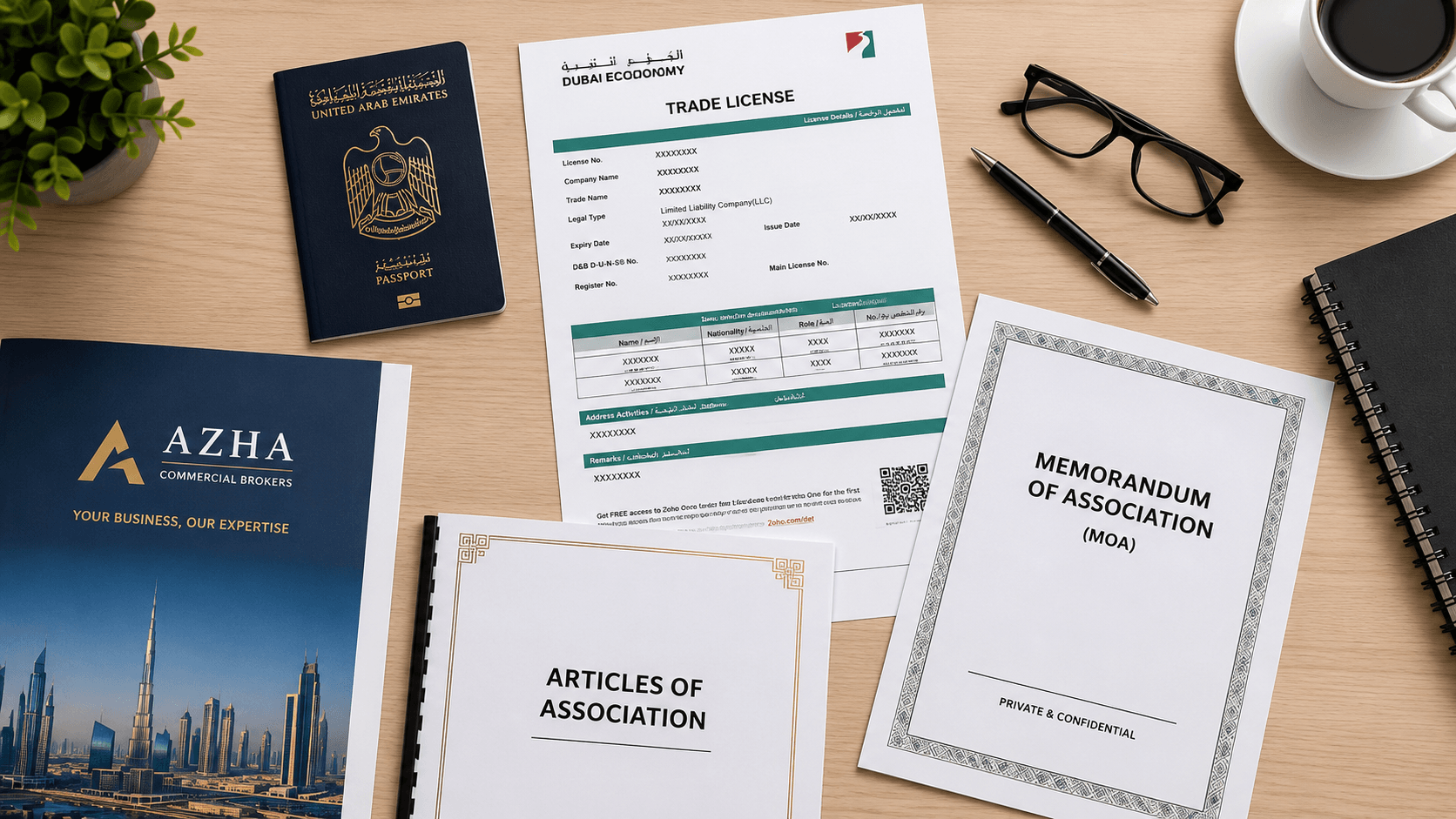
Complete Document Checklist UAE Corporate Bank Account 2026
Free Zone Companies
- Valid trade license (3+ months before expiry)
- Certificate of Incorporation
- Memorandum and Articles of Association (MOA / AOA)
- Share Certificate(s)
- Passport copies all shareholders and directors (clear, valid)
- UAE Residence Visa + Emirates ID (UAE-resident shareholders)
- Office lease / Ejari / flexi-desk agreement
- Business plan (2 pages minimum specific)
- 6 months personal bank statements all shareholders
- Source of funds declaration letter
- Company profile / website
- Board Resolution (multi-shareholder companies)
Mainland Companies (Above + These)
- DED Trade License original + copy
- Local Service Agent Agreement (if applicable)
- NOC from current employer (employed UAE shareholders)
- Ejari-registered tenancy contract
High-Risk Activities (Above + These)
- Regulatory approval / secondary license
- Sample contracts or purchase orders
- Supplier country documentation
- Compliance policy document
How Long Does UAE Corporate Bank Account Opening Take?
Case Type | Timeline |
|---|---|
Digital banks Wio, Liv Business | 5–10 working days |
Standard case, complete documents, low-risk | 2–4 weeks |
Complex case, additional documents required | 4–8 weeks |
High-risk nationality or activity | 6–12 weeks |

Can Azha Commercial Brokers Help Open My UAE Corporate Bank Account?
Yes and the difference between a professional-managed application and an individual application is significant.
We bring three things that individual applicants typically do not have: direct relationships with relationship managers at major UAE banks, knowledge of which banks are currently approving which activity types and nationalities based on cases we submitted last week, and document preparation expertise that eliminates the back-and-forth that adds weeks to most applications.
Our corporate bank account success rate is 98% across all submitted applications. For high-risk cases it is lower, but significantly higher than unassisted applications to the same banks.
Talk to our banking team for a free profile assessment before you approach any bank. Or visit our company bank account service page for full details on our process.
This blog is part of our UAE business setup and banking guide series. Read also: Business Setup in Sharjah: Complete Cost Guide 2026
Call or WhatsApp: +971 52 190 4932